
Buying a new motorcycle is only half the job done. Before you can legally ride it on the road, you need to get it registered with your provincial Excise and Taxation Department, and that comes with its own set of charges. The confusion usually starts here, because Punjab, Sindh, KPK, Islamabad, and Balochistan each calculate fees differently, and the numbers people quote online rarely match what actually gets charged at the counter.
This guide breaks down the registration fee, lifetime token tax, smart card cost, and the documents you actually need, province by province, along with the recent relief measures that briefly changed the picture for bikers in Punjab.
Table of Contents
- Why Bike Registration Matters
- How the Fee Is Calculated
- Punjab Bike Registration Fee
- Sindh Bike Registration Fee
- KPK Bike Registration Fee
- Islamabad and Balochistan
- The 2026 Punjab Relief Package: What Changed
- Documents Required
- Step-by-Step Registration Process
- Penalties for Late Registration
- Common Mistakes to Avoid
- Pros and Cons of Registering On Time
- FAQs
- Final Verdict
Why Bike Registration Matters
An unregistered motorcycle is not just a paperwork gap, it is a legal risk. Traffic police can impound an unregistered bike on the spot, and you will not be able to prove ownership if it gets stolen or if a dispute comes up later. Registration also links your bike to your CNIC in the Excise database, which is what makes number plate verification, insurance claims, and resale transfers possible.
How the Fee Is Calculated
Bike registration cost in Pakistan is not one fixed number. It is a combination of several separate charges:
- Registration fee: charged once, based on engine capacity or invoice value depending on the province
- Lifetime token tax: a one-time tax that replaces annual token payments for most motorcycles
- Smart card fee: covers the plastic ownership card issued in place of the old paper book
- Number plate charges: for the government-issued security number plate
- Additional registration mark fee: a minor administrative charge in some provinces
Because each province’s Excise and Taxation Department sets its own slabs, the same 125cc bike can cost a different amount to register in Lahore compared to Karachi or Peshawar.
Punjab Bike Registration Fee
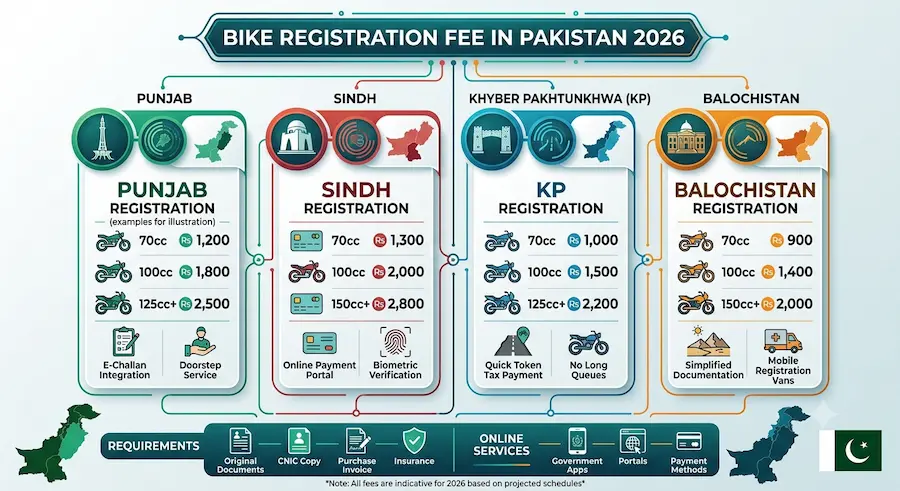
Punjab uses engine capacity to decide the registration fee. According to the Excise and Taxation Department Punjab’s published slabs, the fee structure is:
| Engine Capacity | Registration Fee |
|---|---|
| Up to 70cc | Rs. 1,000 |
| 71cc to 100cc | Rs. 1,500 |
| 101cc to 125cc | Rs. 2,000 |
| 126cc to 150cc | Rs. 2,500 |
| Above 150cc | 2% of the bike’s value |
On top of this, Punjab charges a one-time lifetime token tax instead of an annual payment for most motorcycles. Bikes up to 149cc pay around Rs. 1,800 in lifetime token tax, while 150cc bikes pay closer to Rs. 3,000. Add to that the smart card fee (roughly Rs. 1,300) and the additional registration mark fee (roughly Rs. 1,000), and a standard 70cc bike typically works out to somewhere between Rs. 3,000 and Rs. 4,800 in total, depending on which office and which charges apply to your case.
Electric bikes get a notable break in Punjab: the Excise Department has confirmed a 95% discount on both registration fee and token tax for electric two-wheelers, as part of the province’s push toward green transport.
Sindh Bike Registration Fee
Sindh takes a different approach. Instead of flat slabs by engine size, the Excise, Taxation and Narcotics Control Department calculates the registration fee as roughly 1% of the motorcycle’s factory invoice price. Lifetime token tax is charged upfront for bikes up to 1000cc, and for smaller motorcycles up to 149cc, the annual token tax option can be as low as Rs. 80 per year if you choose not to pay it as a lump sum. A smart card for new registrations costs an additional Rs. 750. Sindh has also abolished ownership transfer fees for motorcycles, which makes it noticeably cheaper to formally transfer a used bike into your name compared to a few years ago.
KPK Bike Registration Fee
Khyber Pakhtunkhwa keeps things simpler for two-wheelers. Motorcycles registered in KPK pay a one-time lifetime token tax of around Rs. 1,000, which is lower than what riders typically pay in Punjab or Sindh for the same engine size. Registration fee slabs are published on the KPK Excise and Taxation Department’s own calculator, and it is worth checking that tool directly since KPK periodically revises its schedule through notification.
Islamabad and Balochistan
Islamabad’s excise wing and the Balochistan Excise and Taxation Department each maintain their own fee notifications, and these are updated less frequently in public reporting compared to Punjab and Sindh. Rather than quoting a number that might be outdated by the time you visit the counter, it is safer to confirm the exact current rate through the respective department’s office or portal before you go in to register, especially if you are registering a bike above 125cc.
The 2026 Punjab Relief Package: What Changed
In early April 2026, Chief Minister Maryam Nawaz announced a relief package for motorcyclists in response to a sharp rise in petrol prices. Under this package, the bike registration fee and transfer fee were waived, and registered motorbike owners became eligible for a monthly subsidy of Rs. 2,000, delivered as a Rs. 100 per litre discount on up to 20 litres of petrol.
The waiver specifically covered the Rs. 605 transfer fee, the Rs. 1,000 additional registration mark fee, and the Rs. 1,300 smart card fee, but it did not extend to the lifetime token tax, which continued to apply as usual. The Excise Department confirmed the exemption ran until May 5, 2026, with normal fee collection resuming from May 6, 2026. If you are registering or transferring a bike now, the standard fee schedule above applies again, though the fuel subsidy scheme itself has continued separately for eligible registered owners.
Documents Required
- Original CNIC of the buyer
- Original sales certificate from the manufacturer (Atlas Honda, Yamaha Motor Pakistan, Pak Suzuki, or equivalent)
- Original commercial sales invoice from the authorized dealership
- Biometric verification of the owner, done at the dealership or an Excise office kiosk
- Passport-size photographs, where still required by the local office
Step-by-Step Registration Process
- Collect the sales certificate and invoice from your dealership at the time of purchase
- Complete biometric verification, either through the dealership’s system or at the Excise office
- Visit your district Excise and Taxation office, or use the province’s online portal (MTMIS for Punjab, excise.gos.pk for Sindh, the KPK Excise calculator and portal for KPK)
- Submit your documents and pay the calculated challan at the bank counter inside the office, or digitally through apps such as ePay Punjab using JazzCash, EasyPaisa, or internet banking
- Keep the payment receipt safe until your registration is confirmed
- Wait for your registration number to be issued and your smart card to be prepared, which can take a few weeks
Penalties for Late Registration
Motorcycles must generally be registered within 30 days of purchase. Riding a bike beyond this window without registering it can result in a penalty of around Rs. 5,000, on top of the standard registration charges you still have to pay. Unregistered bikes are also more likely to be stopped and impounded at checkpoints, which adds further cost and inconvenience.
Common Mistakes to Avoid
- Delaying registration past the 30-day window and getting hit with late fees
- Registering with an expired CNIC, which forces you to redo biometric verification after renewal
- Assuming the fee slab quoted for one province applies everywhere
- Skipping the smart card collection and relying only on a temporary receipt
- Not confirming the current rate before visiting, since provincial notifications do change fee slabs from time to time
Pros and Cons of Registering On Time
| Pros | Cons |
|---|---|
| Legal proof of ownership | Upfront cost at the time of purchase |
| Protection against impoundment and fines | Requires a visit to the Excise office or app setup |
| Eligibility for provincial subsidy schemes, where offered | Processing time for the smart card can take a few weeks |
| Smoother resale or transfer later | Rates vary by province, causing confusion for first-time buyers |
FAQs
How much is the bike registration fee in Pakistan?
It depends on your province and engine capacity. In Punjab, a 70cc bike’s registration fee alone is around Rs. 1,000, rising to Rs. 2,500 for 126cc to 150cc bikes, plus separate token tax and smart card charges. Sindh calculates it as roughly 1% of the invoice price instead of a flat slab.
Is bike registration fee still waived in Punjab?
No. The waiver on registration, transfer, and smart card fees was a temporary relief measure that ran from early April 2026 until May 5, 2026. Normal fee collection resumed from May 6, 2026.
What is lifetime token tax and is it separate from the registration fee?
Yes, it is separate. The registration fee covers entering your bike into the Excise database, while lifetime token tax is a one-time road tax payment that replaces annual token renewals for most motorcycles.
Can I register my bike online?
Punjab and Sindh both offer online portals and apps, including MTMIS and ePay Punjab, that let you check fees and pay challans digitally. Physical document verification and biometric checks are still typically required at least once.
Do electric bikes get any registration discount?
In Punjab, electric two-wheelers currently qualify for a 95% discount on both the registration fee and token tax, as confirmed by the Excise and Taxation Department.
What happens if I do not register my bike within 30 days?
You risk a penalty of around Rs. 5,000 in addition to the standard registration charges, and your bike can be impounded if stopped without valid registration.
Final Verdict
Bike registration in Pakistan is inexpensive compared to the cost of the motorcycle itself, and it is not worth skipping or delaying. Punjab’s slab-based system keeps costs predictable for smaller-engine bikes, Sindh’s invoice-based model can work out cheaper or more expensive depending on your bike’s price, and KPK remains the most affordable for lifetime token tax. Whichever province you are in, confirm the current rate through the official Excise portal before you go in to pay, since relief packages and fee notifications do change during the year, as Punjab bikers saw firsthand in April and May 2026.


